
CRedIBlE Workshop in Vevey: The Sector Is Ready for Circularity, So What's Holding It Back?
May 19, 2026 • Vevey, Switzerland
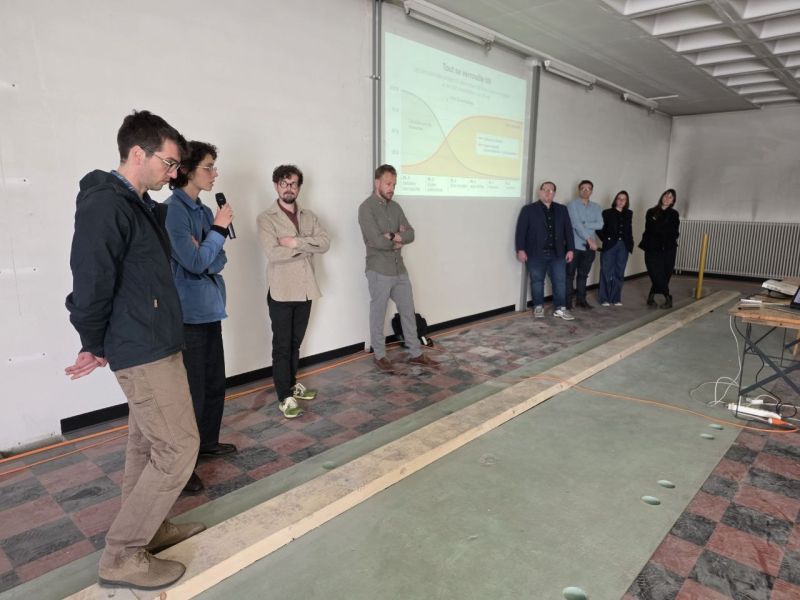
On 19 May 2026, 117 participants braved the cold morning in Vevey and gathered for a CRedIBlE workshop on circular renovation in the French-speaking Swiss context. French Switzerland is embracing the new circularity paradigm, and a growing number of stakeholders across the construction sector are experimenting with new business models, while digital tools are evolving to support these transitions. The CRedIBlE "Swiss Cluster" seeks to be a strong catalyst for change on a larger scale, and the event was an opportunity to share how professional practices are being adapted to integrate circularity across the entire construction value chain.
The workshop brought together the full spectrum of practitioners: project owners, architects and engineers, public authorities, construction companies, and researchers. The event was organized by EPIQR Rénovation, Estia, and the City of Vevey. It was led by two members of the CRedIBlE project, Edouard Philippe (EPIQR Rénovation Sàrl) and Flourentzos Flourentzou (ESTIA SA). A live survey developed with Daniel Wuebben (Universidad Pontificia Comillas) allowed for the conversation to be captured and fostered.
Where do organizations stand regarding circularity?
The day opened with a shared diagnosis. Using live polling, participants were asked to take stock of where they and their organizations actually stand regarding circularity. The results were striking: 83% of the 76 respondents said their organization was ready to integrate circularity into upcoming projects — 39% fully, 44% on selected projects. Readiness is not the problem.
What are the barriers and drivers to decarbonisation in renovations?
Asked to rate the main barriers to low-carbon thinking on a scale of 1 to 5, participants identified financial risk — cost overruns and delays — as the sharpest friction point, scoring 3.7 out of 5. The lack of established supply chains for reuse came close behind at 3.5, followed by insurance and legal liability at 3.1, with regulatory constraints trailing at 2.9. The message was consistent: the sector wants to move, but the systemic conditions haven't caught up yet.
On the question of what actually drives decarbonization in a deep renovation, participants pushed back against the conventional answer. While thermal performance — long the dominant metric — scored only 3.0 out of 5, the preservation rate ranked highest. With an average of 3.8 and 66% of respondents rating it 4 or 5, workshop participants valued keeping as much of the existing structure and materials as possible. Rethinking the intended use of the building came second at 3.1. The workshop results indicate that the field is advancing in reordering its priorities.
What does it take to change practices and incorporate circularity in renovations?
The live polling also revealed something about how practitioners expect to change their own practice. Over half — 55% — said they were counting most on networks and collective intelligence. Another 36% placed their bet on digital tools: CO₂ calculators, cost models, reuse platforms, and AI.
Asked about their confidence in those digital tools specifically, the room split into honest camps: 28% use them regularly, 39% believe in the results but haven't yet integrated them into daily work, 15% think there are already too many, and 15% admitted they weren't sure what a digital tool was. It is crucial to continue investigating these diverse strategies to change practices, as they can reveal concrete yet overlooked barriers and opportunities to scale circularity.
Summary of the workshop
What emerged from the workshop sessions was captured well by Sylvain Braine, one of the panel moderators, who identified eight concrete levers for the road ahead:
- Deciding early: auditing materials makes all the difference.
- Preserving first: existing materials have the lowest carbon footprint, so preserving existing materials should be the default.
- Seriously considering early design factors: form, glazing ratio, basements — 30–40% of the carbon footprint is determined here.
- Work package approach: making each stakeholder accountable for their own impact.
- Integrating advisory/consultancy services from the space allocation planning stage, before floor plans are drawn.
- Developing shared/community storage facilities: without storage solutions, identified materials end up in the landfill.
- Pursuing internal circularity: closing the industry loops, without waiting for regulation.
- Using digital tools as a common language to align architects, engineers, and project owners.
Sylvain also added a note of caution: reducing embodied energy is necessary but not sufficient, as true circularity means designing for end-of-life from the very first sketch.
Program and Panelists
- From research to practice: adapting our approaches and tools — Edouard Philippe, EPIQR Rénovation Sàrl (SME: Digital tool and Service provider, CRedIBlE Partner)
- When deconstruction becomes the driver of low-carbon construction — Jessica Loiseau, Retraites Populaires (Real Estate owner, Pension Fund)
- Anticipating material supply and managing its end-of-life at the territorial scale — Pascal Blunier, DGE-GEODES (Territorial authorities)
- Compose–recompose: learning to build with what is "already there," results from an EPFL architecture studio — Blanca Gardelegui, reuse expert at Zirkular, visiting professor at EPFL 2024 (Swiss Research and academic activities)
- Levers for circularity in low-carbon construction and renovation — Charlotte Jianoux, Estia SA (SME: Digital tool and service provider, CRedIBlE Partner)
- Reuse as a new business niche for Swiss SMEs: from pioneering projects to the industrialization of reuse — Théo Martin, Wider SA (SME: woodwork sector, CRedIBlE Partner)
- Prefabrication as a driver of low-carbon solutions — Jérémy Bras, Prelco SA (SME: prefab concrete sector)
- Supporting and encouraging the evolution of practices in circular economy — Antoine Dormond, City of Vevey (Communal authorities, CRedIBlE Partner)
Next steps
The workshop ran out of time before participants ran out of ideas — which, for a first edition, is exactly where you want to be. Next steps within the CRedIBlE project include further discussions with construction and renovation stakeholders at other pilot sites.