
CRedIBlE project kick-off meeting
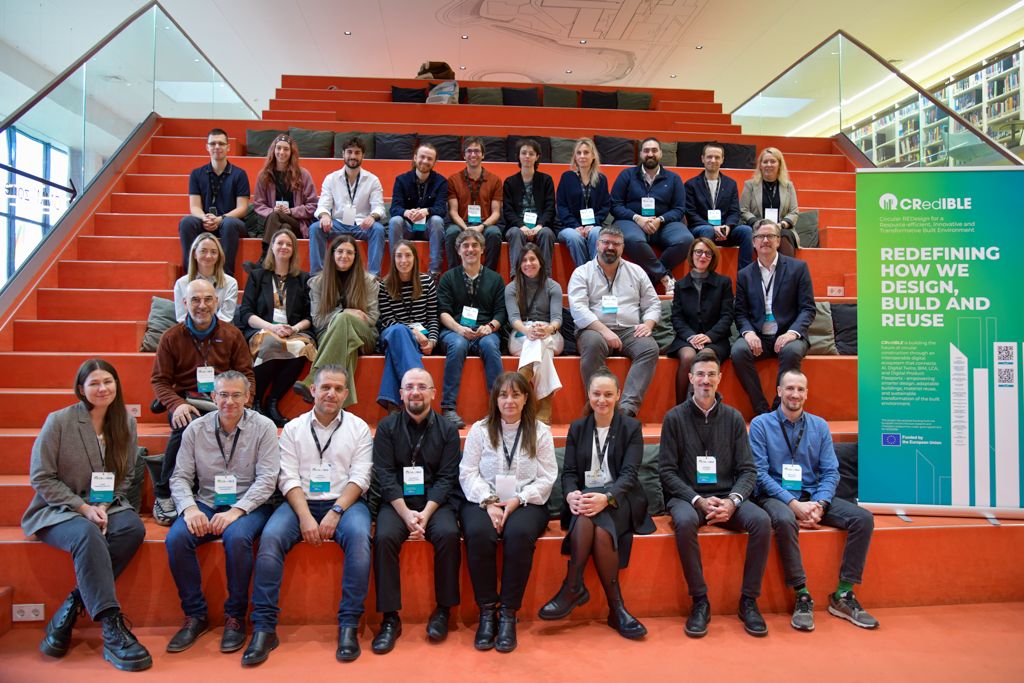
The launch of the CRedIBlE project marked the beginning of an ambitious four-year journey to rethink how Europe renovates, adapts, and reuses its existing building stock. Officially starting on 1 October 2025 under Horizon Europe Cluster 5, CRedIBlE brings together 18 partners from across Europe, combining academic excellence, industrial innovation, digital expertise, and public-sector leadership around a shared objective: accelerating the transition towards a circular, resource-efficient, and climate-resilient built environment.
This journey began with two complementary kick-off moments. A first virtual meeting in October set the strategic and organisational foundations, ensuring that all partners—despite geographical distance—shared a common understanding of the project’s vision, structure, and immediate priorities. One month later, the consortium gathered in Kaunas, Lithuania, for an intensive two-day face-to-face kick-off meeting, transforming initial alignment into deep technical discussion, concrete planning, and collective momentum.
Together, these two meetings tell the story of how CRedIBlE moved from concept to coordinated action.
A virtual starting point: aligning vision, roles, and expectations
The virtual kick-off meeting, held on 10 October 2025, was the consortium’s first collective milestone. At this early stage, the objective was not technical depth, but clarity: clarity on why CRedIBlE exists, how it is structured, and what is expected from each partner during the critical first months of implementation.
The project coordinator, Kaunas University of Technology (KTU), formally opened the meeting by outlining the scope of CRedIBlE: a four-year project with a budget close to €4 million, built on lessons learned from previous European initiatives such as SmartWins. The emphasis was clear from the outset: CRedIBlE is not about reinventing tools in isolation, but about integrating existing digital solutions, material innovations, and methodologies into a coherent ecosystem that supports circular decision-making in real renovation and adaptive reuse contexts.
During this virtual session, partners were introduced to the overall architecture of the project. CRedIBlE follows a phased logic—Design, Develop, Deploy, and Capacity Building—ensuring that conceptual frameworks, digital tools, and material innovations are progressively validated in real-world pilot sites before being translated into scalable solutions and policy-relevant insights.
The virtual kick-off also clarified which work packages would be immediately active. WP1 (Project Specification and Positioning), WP7 (Project Management), and WP8 (Dissemination and Exploitation) were identified as the backbone of the first implementation phase. Their role is foundational: defining baselines and KPIs, setting governance and quality procedures, and ensuring that results are communicated, protected, and prepared for long-term uptake.
Equally important was the introduction of the six pilot sites located in Spain, Switzerland, Lithuania, Cyprus, and Romania. These pilots, diverse in function, age, regulatory context, and social role, embody the project’s ambition to address circular renovation not as a theoretical exercise, but as a practical response to real constraints and opportunities on the ground.
Finally, the virtual meeting addressed the often invisible but essential elements of project success: financial flows, reporting obligations, communication rules, peer-review processes for deliverables, and the use of shared collaboration tools. By the end of the session, partners left with a clear roadmap for the first months and a shared commitment to meet again in person to deepen the discussion.
Kaunas: turning alignment into collaboration
If the virtual kick-off established a common language, the physical meeting in Kaunas, held on 19–20 November 2025, gave that language substance. Over two full days, the consortium moved from high-level vision to detailed technical coordination, confronting the complexity of circular renovation through open discussion, workshops, and cross-disciplinary exchange.
The meeting opened with welcome remarks from KTU and an intervention from the project officer representing CINEA, who reminded partners of the importance of alignment between the Grant Agreement, reported activities, and delivered outcomes. This framing set the tone for the days ahead: ambition must go hand in hand with rigour, traceability, and quality control.
Designing the foundations: WP1 as the project compass
A significant portion of the first day focused on WP1, which acts as the conceptual and methodological compass of CRedIBlE. Discussions highlighted the importance of establishing a robust baseline for sustainability, circularity, and adaptability in the built environment, as well as defining KPIs that are both scientifically sound and operationally meaningful.
Stakeholder mapping and needs analysis emerged as a critical challenge and opportunity. With pilot sites embedded in different regulatory, cultural, and socio-economic contexts, the consortium recognised that circular solutions cannot be imposed uniformly. Instead, they must be co-designed with local actors, accounting for regional constraints, market conditions, and user expectations.
Equally strategic was the design of the digital ecosystem architecture. Rather than developing isolated platforms, CRedIBlE aims to ensure interoperability between BIM, life-cycle assessment tools, digital twins, decision-support systems, and digital product passports. The Kaunas discussions underscored the need for modular, scalable, and GDPR-compliant architectures capable of evolving beyond the project itself.
From architecture to tools: advancing digital innovation
WP2 sessions brought technical depth to the meeting, detailing how digital tools will be developed, integrated, and validated. Partners presented plans for BIM-to-LCA integration, AI-powered decision support systems, and digital twins capable of real-time monitoring and scenario simulation.
What made these discussions particularly valuable was the emphasis on interdependencies. The success of each tool depends on shared data standards, aligned assumptions, and early coordination between developers and end-users. The Kaunas meeting allowed partners to identify potential bottlenecks early—data availability, interoperability risks, validation methodologies—and to agree on regular coordination mechanisms to mitigate them.
Validation was another recurring theme. Rather than treating testing as a final step, CRedIBlE embeds validation throughout the development cycle, using controlled environments and pilot sites to iteratively refine tools based on real feedback.
Material innovation at the core of circularity
Day two shifted focus towards WP3 and the development of circular building materials and systems. Presentations showcased ongoing work on low-carbon, recycled, and CO₂-storing materials, modular and disassemblable construction systems, and the integration of material data into digital product passports.
These discussions highlighted one of the project’s defining features: the close coupling between physical materials and digital intelligence. Circularity, in CRedIBlE, is not only about material composition, but about traceability, future reuse, and informed decision-making across the building lifecycle.
Debates around carbon storage, regulatory frameworks, and performance indicators illustrated the complexity of aligning innovation with evolving European standards. Rather than seeing this as a barrier, the consortium framed it as an opportunity to contribute to ongoing policy discussions through evidence generated in the project.
Pilot sites as living laboratories
Perhaps the most tangible moments of the Kaunas meeting came from the presentation of the pilot sites. Each site—whether a heritage building in Lithuania, a former industrial facility in Switzerland, or public buildings in Spain and Romania—was discussed not just as a testbed, but as a living laboratory where technical, social, and regulatory dimensions intersect.
Partners explored how different tools and materials could be deployed in each context, what data would be required, and how changes of use might reshape stakeholder engagement. These conversations made clear that pilots are not endpoints, but learning environments that will continuously inform the project’s evolution.
Beyond technology: exploitation, dissemination, and long-term impact
The meeting also dedicated time to exploitation planning and intellectual property management. Rather than postponing these questions, CRedIBlE integrates them from the outset, ensuring that key exploitable results—digital platforms, methodologies, and material systems—are positioned for uptake beyond the project’s lifetime.
Dissemination was framed as a collective responsibility. Partners committed to coordinated communication, alignment with European initiatives such as Built4People, and the production of outputs that speak not only to experts, but also to policymakers, practitioners, and communities.
A shared starting line
As the Kaunas meeting concluded, one message was clear: CRedIBlE has moved decisively from planning to action. The virtual kick-off provided the necessary alignment; the face-to-face meeting transformed that alignment into trust, shared understanding, and operational clarity.
The coming months will test this foundation through data collection, tool development, and early stakeholder engagement. Yet the strength of the kick-off process—combining strategic vision, technical depth, and collaborative spirit—has positioned the consortium to navigate complexity with confidence.
CRedIBlE’s journey has only just begun, but its first steps already reflect the project’s core ambition: to turn circularity in the built environment from aspiration into practice, grounded in real buildings, real data, and real collaboration.